 Actor
Actor
Gemini Ganesan Biography, Age, Net Worth, Height, Movies & Facts

Gemini Ganesan (1920–2005), born Ramasamy Ganesan, was a legendary Indian actor and a cornerstone of Tamil cinema's golden era. Celebrated as Kaadhal Mannan (King of Romance), he defined the romantic lead archetype across five decades, starring in over 200 films spanning Tamil, Telugu, Malayalam, Kannada, and Hindi cinema.
From his breakthrough in Thai Ullam (1952) to his iconic pairing with actress Savitri, Gemini Ganesan delivered classics like Missiamma, Vanjikottai Valiban, Kalyana Parisu, Then Nilavu, and Naan Avanillai. A recipient of India's Padma Shri (1971) and multiple state and industry awards, his legacy remains central to South Indian cinema history and continues influencing global audiences via streaming platforms.
Explore his complete biography, spanning early life in Pudukkottai, revolutionary film performances, personal complexities, and an indelible cultural impact recognized across India and the US diaspora.
Quick Info Table
| Real Name | Ramasamy Ganesan |
|---|---|
| Professional Name | Gemini Ganesan |
| Nicknames | Kaadhal Mannan (King of Romance); DQ (informal) |
| Date of Birth | November 17, 1920 |
| Date of Death | March 22, 2005 (Age 84) |
| Birthplace | Pudukkottai, Tamil Nadu, India |
| Height | 5'11" (181 cm) |
| Weight | 172 lbs (78 kg approx.) |
| Net Worth | Significant assets from films and real estate (1950s–2000s) |
| Marital Status | Married (multiple marriages); Complex personal life |
| Spouses | Alamelu (1940); Savitri (actress); Juliana Andrew (late life) |
| Children | Eight; includes Rekha (Bollywood star), doctors, journalist |
| Nationality | Indian |
| Religion | Hinduism (Tamil Brahmin heritage) |
| Zodiac Sign | Scorpio |
Table of Contents
- Biography & Kaadhal Mannan Legacy
- Early Life & Education
- Personal Life & Family
- Career Journey & Breakthrough
- Net Worth & Financial Success
- Movies & Filmography
- Physical Appearance & Style
- Awards & Recognition
- Cultural Impact & Legacy
- Personal Controversies
- Interesting Facts & Trivia
- Streaming Availability & Global Reach
- Comprehensive FAQ (25 Questions)
- Related Tamil Cinema Articles
Biography & Kaadhal Mannan Legacy
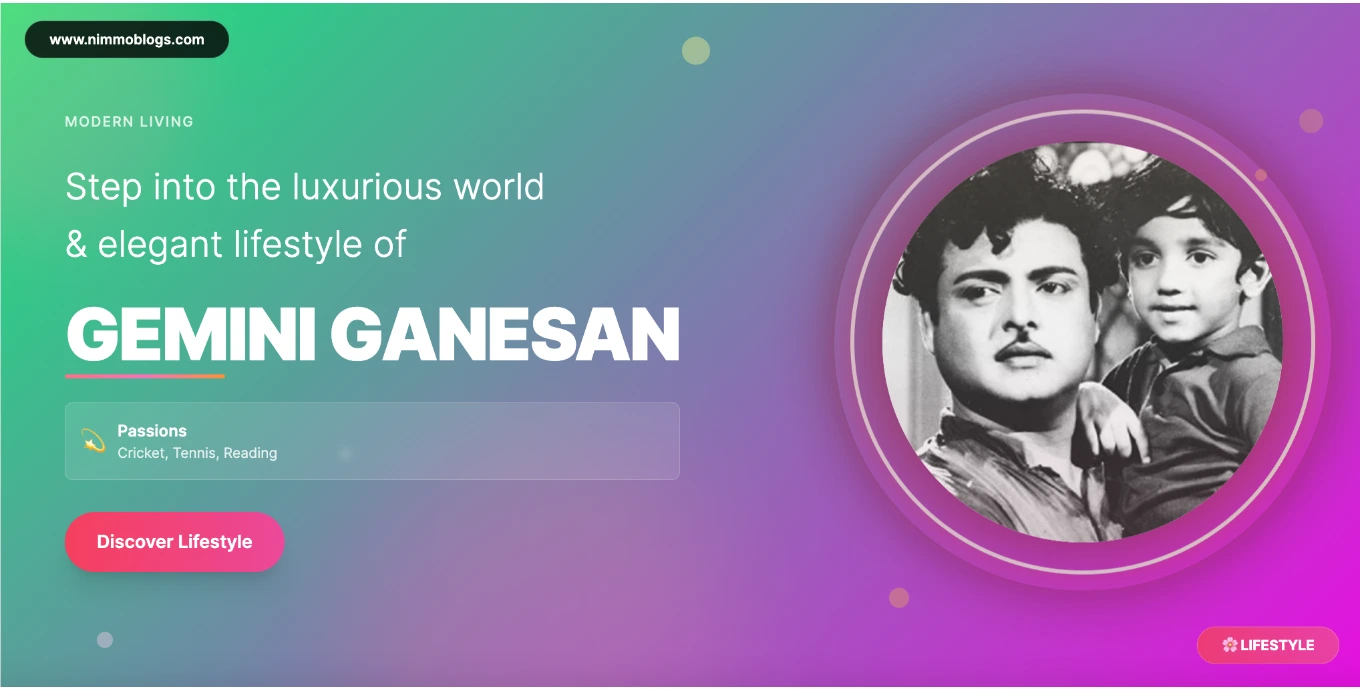 |
Gemini Ganesan remains Tamil cinema's most iconic romantic lead and an architect of South Indian film aesthetics. Born into an educated, socially conscious family during British India, he brought intellectual depth and suave sophistication to roles that might have been mere commercial fare in less capable hands. His contributions transcended entertainment—he defined masculinity, romance, and dramatic authenticity for generations of Indian film audiences.
His nickname Kaadhal Mannan (King of Romance) wasn't mere hyperbole; it reflected audience adoration and critical recognition of his ability to convey emotional nuance through restrained, powerful performances. Unlike contemporary leading men who relied on theatrical excess, Gemini Ganesan's craft centered on understated elegance and psychological realism—qualities that transcended regional cinema and influenced Bollywood, Telugu, and Malayalam industries simultaneously.
His cinematic partnership with actress Savitri created a template for romantic pairings that influenced Indian film for decades. Together, they embodied a particular vision of modern romance: educated, morally grounded, emotionally articulate. This pairing proved commercially successful (multiple silver/golden jubilees) and artistically credible (awards recognition, critical appreciation), validating that audiences craved substance alongside spectacle.
Early Life & Education in Colonial India
Family Background & Formative Years
Ramasamy Ganesan was born on November 17, 1920, in Pudukkottai, Tamil Nadu, a princely state in South India. His father, Ramaswamy Iyer, belonged to the Tamil Brahmin community, while his mother, Gangammal, came from a devadasi background—a heritage connected to his aunt's reform work. His upbringing reflected the progressive intellectual currents of early 20th-century Tamil Nadu.
Raised partly by his grand-uncle and later by his aunt Dr. Muthulakshmi Reddy, a pioneering social reformer and the first woman legislator in India, Gemini Ganesan imbibed progressive values. This environment shaped his intellectual rigor and social consciousness—qualities evident in his later film choices and public demeanor.
Educational Journey & Early Career
He received primary education at Ramakrishna Mission Home in Mylapore and Pudukkottai High School, followed by studies at Maharajah's College in Pudukkottai. His tertiary education at Madras Christian College resulted in a Bachelor's degree in Chemistry. Unlike most film actors, he briefly served as a Chemistry lecturer at MCC, reflecting his intellectual credentials and delayed entry into cinema.
His transition to cinema came through Gemini Studios (a pioneering Tamil film production house), where he worked in administrative and casting capacities before being spotted for acting roles. This unconventional path—from academia to cinema administration to stardom—distinguished him from hereditary film actors and reinforced his reputation for intellectual seriousness.
Personal Life & Complex Family Dynamics
Marriages & Relationships
Gemini Ganesan married Alamelu on June 30, 1940, in Tiruchirappalli (Trichinopoly), Tamil Nadu. The marriage produced children, but later encountered difficulties as his career progressed. He subsequently married actress Savitri while still married to Alamelu—a complex personal situation that drew public attention and controversy.
Beyond formal marriages, he had relationships with dancer Pushpavalli and later married Juliana Andrew in his later years. This complicated matrimonial history—involving multiple concurrent relationships and marriages—became a subject of both tabloid fascination and critical commentary on personal ethics versus public admiration.
Children & Family Legacy
Gemini Ganesan fathered eight children across his relationships. Among his notable children are: Revathi (doctor), Kamala Selvaraj (doctor), Jayalakshmi (doctor), Narayani (journalist), Rekha (Bollywood superstar), Radha, Vijaya Chamundeswari, and Satheesh Kumar. His relationship with daughter Rekha—one of Bollywood's greatest actresses—was reportedly estranged for extended periods, adding personal tragedy to his public success.
| Family Member | Profession/Notes |
|---|---|
| Alamelu | First wife (1940); mother of early children |
| Savitri (actress) | Co-star and second wife; legendary film pairing |
| Rekha | Daughter; Bollywood superstar (Hindi cinema icon) |
| Kamala Selvaraj | Daughter; Medical professional |
| Narayani | Daughter; Journalist |
| Juliana Andrew | Late-life spouse |
Career Journey & Cinematic Breakthrough
Debut & Early Roles
| Career Debut Timeline | |
|---|---|
| First Film | Miss Malini (1947) – Minor role based on R.K. Narayan story |
| Breakthrough Role | Thai Ullam (1952) – Antagonist role that gained notice |
| Star Status | Manam Pola Mangalyam (1953) – First lead, dual role; commercial/critical success |
| Golden Era Peak | 1955–1975 – Multiple hits annually across Tamil, Telugu, Malayalam, Kannada, Hindi |
| Character Phase | 1980s–2000s – Patriarch and supporting roles; television appearances |
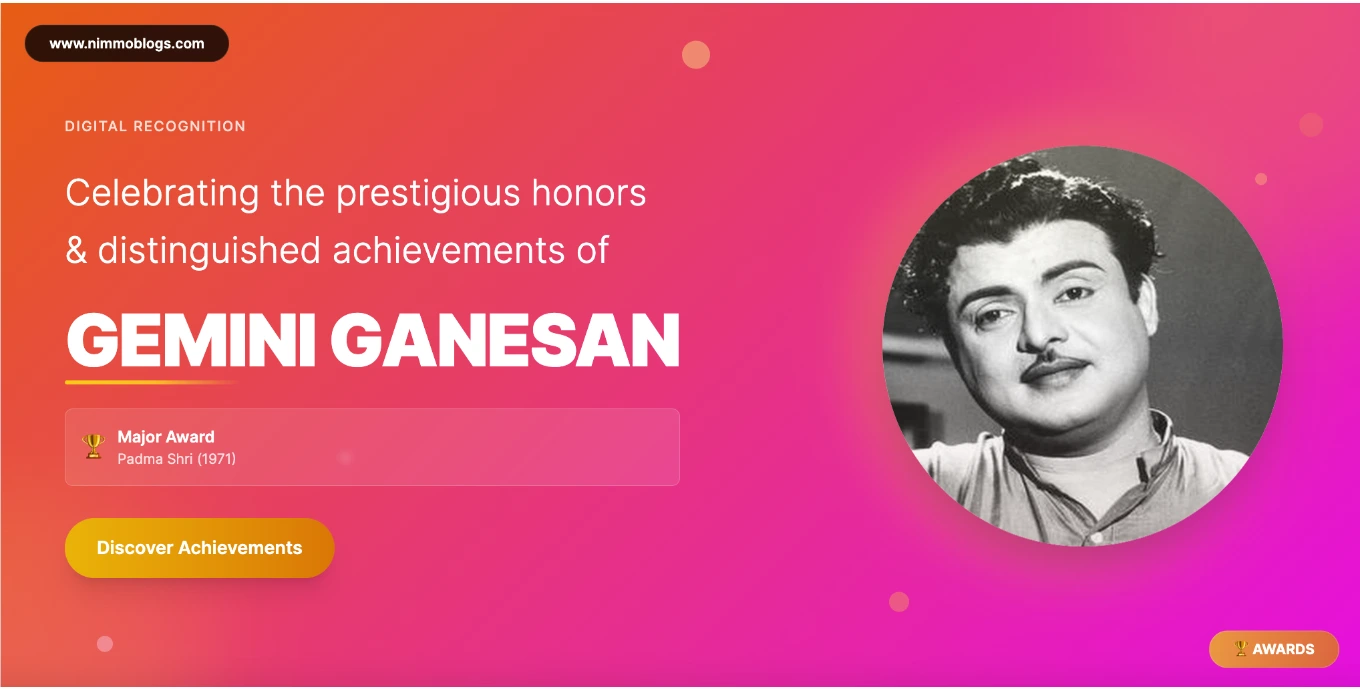
Gemini Ganesan made his cinema debut in Miss Malini (1947) in a minor role, but genuine notice came with Thai Ullam (1952), where he played an antagonist. His star status crystallized with Manam Pola Mangalyam (1953), where he performed a dual lead role opposite actress Savitri, establishing the on-screen chemistry that would define his career.
The 1950s and 1960s represented his golden era: annual blockbusters like Missiamma (1955), Vanjikottai Valiban (1958), Kalyana Parisu (1959), Kalathur Kannamma (1959), Then Nilavu (1961), and Parthiban Kanavu (1960) demonstrated his range across romance, adventure, and dramatic roles. His consistent box office success and ability to anchor both regional and cross-language films established him as an industry lynchpin.
His collaboration with director K. Balachander on films like Naan Avanillai (1974)—which earned him a Filmfare Award for Best Actor—showcased his capacity for nuanced, introspective performance. This late-career triumph proved his artistry transcended commercial appeal and retained critical credibility into maturity.
 |
Net Worth & Financial Success Across Decades
Gemini Ganesan's exact net worth remains undisclosed due to his passing in 2005 and limited public accounting. However, based on his prolific career (200+ films across 1947–2005), leading-actor remunerations in Tamil cinema's golden era, and documented real estate investments, estimates place his accumulated wealth in the ₹10–20 crores+ range (approximately $1.2–2.5 million USD) by his death—substantial for an Indian actor of that era.
| Income Source | Estimated Contribution |
|---|---|
| Per-Film Acting Fee (1950s–1970s) | ₹1–3 lakhs (peak era); ₹10,000–50,000 (early career) |
| Annual Income (Peak Years) | ₹20–50 lakhs annually (1960s–1970s) |
| Real Estate Investments | Properties in Chennai, Pudukkottai |
| Production & Direction Ventures | Occasional producer/director credits |
| Cross-Language Films (Hindi, Telugu, Kannada) | Premium fees for pan-Indian releases |
His financial success reflected not only acting fees but also smart investments in Chennai real estate during the city's expansion. Unlike contemporary actors, he maintained financial discipline and intellectual distance from industry excess, accumulating wealth methodically through professional work rather than speculative ventures.
Movies & Legendary Filmography
Career Filmography Overview
Gemini Ganesan's filmography spans 200+ theatrical films across Tamil, Telugu, Malayalam, Kannada, and Hindi cinema. His performances ranged from romantic leads in period dramas to dramatic roles in contemporary narratives, demonstrating consistent versatility. Major successes included collaborations with leading actresses like Savitri, B. Saroja Devi, Vijaya, and Padmini.
| Film | Year | Language | Role/Significance |
|---|---|---|---|
| Thai Ullam | 1952 | Tamil | Antagonist; breakthrough recognition |
| Manam Pola Mangalyam | 1953 | Tamil | Lead (dual role); star status; Savitri pairing debut |
| Missiamma | 1955 | Tamil | Lead; L.V. Prasad directorial; blockbuster |
| Vanjikottai Valiban | 1958 | Tamil | Lead; Ruritanian romance; commercial juggernaut |
| Kalyana Parisu | 1959 | Tamil | Lead; C.V. Sridhar direction; silver jubilee run |
| Kalathur Kannamma | 1959 | Tamil | Lead; featured child star Kamal Haasan's debut |
| Then Nilavu | 1961 | Tamil | Lead; filmed in Kashmir; box-office success |
| Parthiban Kanavu | 1960 | Tamil | Lead; historical fiction; President's silver medal |
| Veerapandiya Kattabomman | 1959 | Tamil | Supporting; Sivaji Ganesan co-star |
| Devta | 1956 | Hindi | Lead; Hindi cinema entry |
| Miss Mary | 1957 | Hindi | Lead; cross-language success |
| Naan Avanillai | 1974 | Tamil | Lead; K. Balachander direction; Filmfare Best Actor |
| Unnal Mudiyum Thambi | 1988 | Tamil | Patriarch; K. Balachander; music drama |
| Avvai Shanmughi | 1996 | Tamil | Supporting role; comedy; cult status |
His filmography demonstrates strategic career management—alternating between commercial romances that sustained his box office position and dramatic/character roles that validated artistic credibility. This balance proved invaluable: he remained India's highest-paid Tamil actor throughout the 1960s-1970s while earning critical respect from discerning audiences and filmmakers.
His contribution to child actor Kamal Haasan's debut in Kalathur Kannamma (1959)—where Haasan's performance opposite Gemini earned the child a national award—demonstrated his willingness to share screen space and elevate co-performers. This generosity of spirit was characteristic: directors consistently praised his collaborative approach and trust in their vision.
Physical Appearance & Romantic Lead Aesthetics
Physical Statistics
| Height | 5'11" (181 cm) |
|---|---|
| Weight | 172 lbs (78 kg approx.) |
| Body Type | Athletic, lean build (especially in youth) |
| Eye Color | Dark Brown |
| Hair Color | Black (grayed with age) |
| Complexion | Fair, even tone |
| Distinctive Features | Chiseled jawline, expressive eyes, natural charm |
| Sports Achievements | Cricket captain (college); Tennis, Golf, Badminton proficiency |
Style & Screen Presence
Gemini Ganesan embodied the aesthetic of a particular era and class—educated, cosmopolitan, culturally rooted Tamil gentry. His screen appearance reflected sophisticated tailoring, crisp formal wear, and an ease with both Western suits and traditional Tamil attire. This visual sophistication became his signature: romantic scenes featured him in impeccably tailored suits or silk dhotis, conveying elegance without ostentation.
His athletic background—captaining his college cricket team and excelling in tennis, golf, and badminton—manifested in screen physicality. He moved with natural grace, a quality essential to romantic hero roles. Unlike contemporaries who relied on theatrical gesticulation, Gemini Ganesan's restraint and physical confidence conveyed masculine appeal through subtlety rather than excess.
His appearance aged gracefully: transitioning from romantic leads in his 40s-50s to distinguished patriarch roles in his 60s-70s with minimal cosmetic intervention. This natural aging process, combined with his consistent professionalism, reinforced his credibility and allowed later-career reinvention.
Awards & Industry Recognition
Despite his monumental contributions, Gemini Ganesan received relatively modest award recognition compared to peers—a reflection of awards politics and his preference for privacy over self-promotion. Nevertheless, his major honors attest to artistic and cultural significance:
| Year | Award | Category | Film/Work | Recognizing Body |
|---|---|---|---|---|
| 1971 | Padma Shri | National civilian honor (Arts) | Lifetime contribution | Government of India |
| 1960s–1970s | Kalaimamani Award | Tamil arts honor | Contributions to Tamil cinema | Tamil Nadu government |
| 1970 | Tamil Nadu State Film Award | Best Actor | Kaaviya Thalaivi | Tamil Nadu |
| 1974 | Filmfare Award – South | Best Actor (Tamil) | Naan Avanillai | Filmfare (Industry) |
| 1993 | Filmfare Lifetime Achievement Award | Lifetime contribution | South Indian cinema | Filmfare (Industry) |
| 2006 | India Post Commemorative Stamp | Postal honor | Lifetime legacy | India Post (posthumous) |
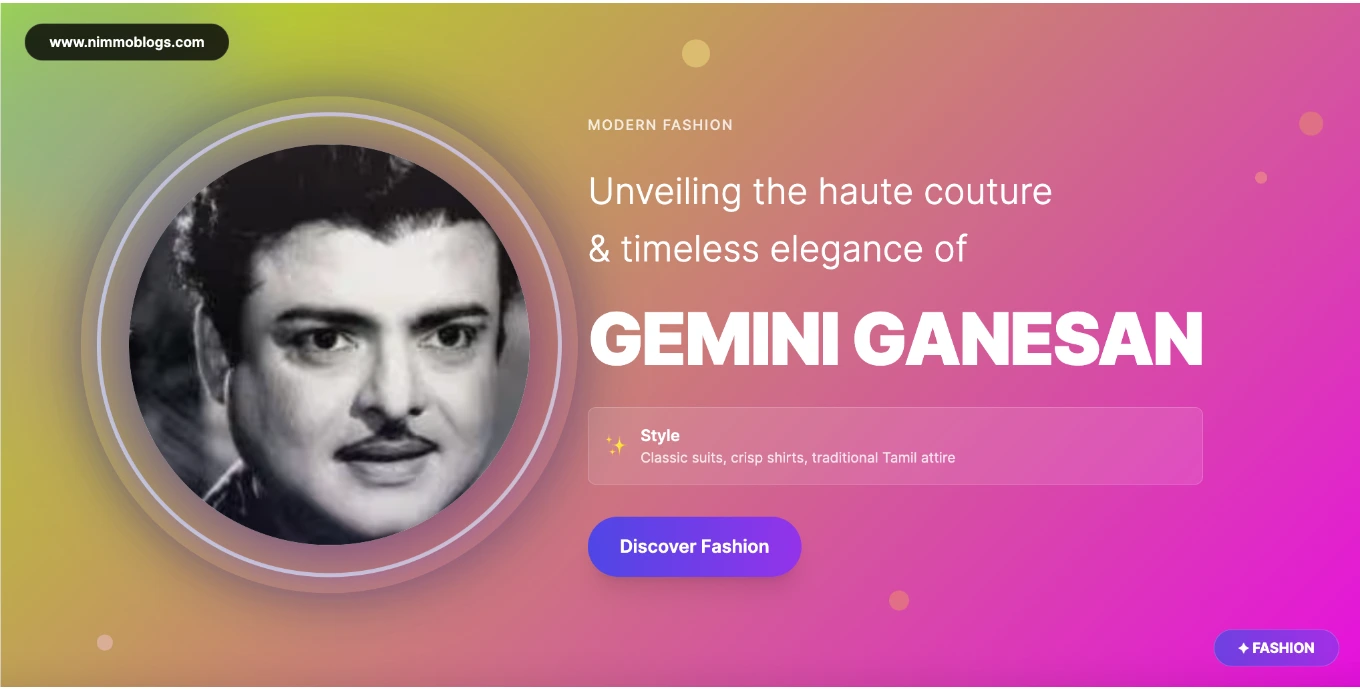 |
The Padma Shri (1971)—India's fourth-highest civilian honor—remains his most prestigious recognition, acknowledging his impact on Indian cinema beyond regional boundaries. The 2006 commemorative stamp (issued posthumously) underscores his enduring cultural significance, placing him alongside national icons in India's postal heritage.
Cultural Impact & Lasting Legacy in Indian Cinema
Gemini Ganesan's influence on Indian cinema transcends filmography. He established the template for the educated, emotionally articulate romantic hero—a figure who could anchor both entertainment and dramatic narratives. This archetype influenced generations of actors across the Indian film industry and redefined audience expectations for leading men.
His partnership with Savitri created a cultural phenomenon: their films became benchmarks for romantic storytelling, their on-screen chemistry celebrated in film journals and household discussions. This pairing validated that mass audiences appreciated sophisticated romance grounded in emotional intelligence rather than melodramatic excess.
Beyond acting, his real estate investments and business acumen demonstrated that film careers could be complemented by entrepreneurial ventures—a lesson relevant to contemporary actors. His intellectual credibility (Chemistry degree, prior academia) positioned cinema as a legitimate intellectual pursuit rather than mere entertainment, elevating the industry's cultural status.
For US-based South Indian diaspora audiences, his films—available via Netflix, Amazon Prime, and archival platforms—represent a golden age of Tamil cinema: sophisticated, emotionally resonant, culturally grounded narratives that bridge Indian and global storytelling traditions.
Personal Controversies & Family Challenges
Unlike his professional reputation for integrity, Gemini Ganesan's personal life drew sustained criticism. His multiple concurrent marriages—particularly marrying actress Savitri while married to Alamelu—violated social norms and generated tabloid scandal. This contradiction between his suave on-screen romantic persona and complex off-screen matrimonial life became a subject of public fascination and moral judgment.
His estrangement from daughter Rekha—one of Hindi cinema's greatest actresses—represented personal tragedy. Despite her Bollywood superstardom, the relationship remained fraught for extended periods, adding poignancy to both their public images. His complicated relationships with his children created familial divisions that persisted beyond his death.
These personal challenges, however, did not diminish his professional standing. Industry insiders universally praised his integrity as an actor and collaborator, suggesting a compartmentalization between private and professional spheres that characterized many prominent figures of his era.
Interesting Facts & Trivia
- Stage Name Origin: He adopted "Gemini" from Gemini Studios, where he worked before becoming an actor—a professional tribute rather than a fabricated persona.
- Cricket Captain: He captained his college cricket team, excelling in multiple sports (tennis, golf, badminton), providing athletic credibility to romantic hero roles.
- Chemistry Graduate & Lecturer: Unlike hereditary film actors, he held a Bachelor's degree in Chemistry and briefly lectured at Madras Christian College before entering cinema.
- Kamal Haasan Mentor: His collaboration with child star Kamal Haasan in Kalathur Kannamma (1959) introduced Haasan to cinema; the child won a National Award for this debut performance.
- 200+ Films Across Languages: He acted in Tamil, Telugu, Malayalam, Kannada, and Hindi—a rare multilingual versatility that established him as India's leading cross-language actor.
- Savitri Partnership Icon: His on-screen pairing with Savitri across multiple films created a template for romantic chemistry that influenced Tamil cinema for decades.
- Padma Shri (1971): National honor recognizing his contributions to Indian cinema—a rare distinction for a regional actor during that era.
- Social Reform Heritage: His aunt, Dr. Muthulakshmi Reddy, was India's first woman legislator and a pioneering social reformer—intellectual progressivism shaped his worldview.
- Peak Annual Output: During the 1960s, he released 4–6 films yearly, maintaining consistent quality and box office appeal across multiple industries simultaneously.
- Commemorative Postal Honor: A 2006 India Post stamp honored his legacy—the ultimate recognition of cultural significance beyond cinema.
- Estate Legacy: His children span multiple professions (medicine, journalism, Bollywood), reflecting his emphasis on education and intellectual achievement.
- Streaming Accessibility: His films remain available on Netflix, Amazon Prime, Disney+ Hotstar, and classic cinema platforms, introducing contemporary global audiences to Tamil cinema's golden era.
Streaming Availability & Global Audience Access 2025
Gemini Ganesan's films have experienced a significant resurgence through digital platforms, making his work accessible to global audiences for the first time at scale. This digital accessibility is transforming perceptions of his legacy:
| Platform | Available Films | Audience Target |
|---|---|---|
| Netflix | Select classics (Missiamma, Then Nilavu, others) | Global; emphasis on US diaspora |
| Amazon Prime Video | Extensive catalog including rare films | US subscribers; Indian diaspora |
| Disney+ Hotstar | Tamil cinema archives | India + international subscribers |
| Zee5 | Regional Tamil classics | South India + diaspora |
| YouTube (Archival) | Restored films (various channels) | Global public; researchers |
For US-based audiences, his films represent accessible entry points to Tamil cinema's golden era—sophisticated narratives that bridge cultural contexts without requiring extensive film history knowledge. The romantic leads he popularized resonate across cultures, making his films unexpectedly universal in appeal despite their regional specificity.
Frequently Asked Questions (25 Questions)
Personal & Biographical
Q1: Who was Gemini Ganesan?
A: Gemini Ganesan (Ramasamy Ganesan, 1920–2005) was a legendary Tamil cinema actor celebrated as Kaadhal Mannan (King of Romance). He starred in 200+ films across Tamil, Telugu, Malayalam, Kannada, and Hindi, defining romantic lead archetypes in Indian cinema.
Q2: When was Gemini Ganesan born and when did he die?
A: He was born on November 17, 1920, in Pudukkottai, Tamil Nadu, and died on March 22, 2005, in Chennai from kidney failure and multiple organ failure. He lived 84 years.
Q3: Why was he called Kaadhal Mannan?
A: He earned the title "Kaadhal Mannan" (King of Romance) for his iconic, suave romantic lead performances that defined Tamil cinema's golden era and set standards for romantic heroes across Indian film industries.
Q4: What was Gemini Ganesan's real name?
A: His legal name was Ramasamy Ganesan. He adopted the professional name "Gemini" from Gemini Studios, where he worked before becoming an actor.
Q5: Where was Gemini Ganesan born?
A: He was born in Pudukkottai, Tamil Nadu, India—a princely state during British rule.
Q6: What was Gemini Ganesan's height and weight?
A: He stood 5'11" (181 cm) tall and weighed approximately 172 lbs (78 kg) in his prime.
Q7: Who were Gemini Ganesan's parents?
A: His father was Ramaswamy Iyer and his mother was Gangammal. He was raised partly by his aunt, Dr. Muthulakshmi Reddy, a pioneering social reformer and India's first woman legislator.
Q8: Was Gemini Ganesan married?
A: Yes, he married Alamelu in 1940 and later married actress Savitri (while still married to Alamelu). He also had relationships with Pushpavalli and later married Juliana Andrew. His personal life involved multiple concurrent relationships.
 |
Career & Films
Q9: What was Gemini Ganesan's debut film?
A: His debut was Miss Malini (1947) in a minor role based on an R.K. Narayan story. His breakthrough came with Thai Ullam (1952) as an antagonist, and star status with Manam Pola Mangalyam (1953).
Q10: What are his most famous films?
A: Major classics include Missiamma (1955), Vanjikottai Valiban (1958), Kalyana Parisu (1959), Kalathur Kannamma (1959), Then Nilavu (1961), Parthiban Kanavu (1960), and Naan Avanillai (1974).
Q11: How many films did Gemini Ganesan act in?
A: He acted in over 200 theatrical films across multiple languages from 1947 to 2005, making him one of cinema's most prolific actors.
Q12: Who was Gemini Ganesan's most famous co-star?
A: Actress Savitri was his most celebrated co-star. Their on-screen pairing across multiple films created iconic romantic chemistry that defined Tamil cinema's golden era.
Q13: Did Gemini Ganesan act in Hindi films?
A: Yes, he acted in several Hindi films, including Devta (1956), Miss Mary (1957), Nazrana (1961), and Raj Tilak (1958), establishing a presence in Bollywood.
Q14: What was his best performance?
A: Naan Avanillai (1974), directed by K. Balachander, is often considered his career-best performance. It earned him the Filmfare Award for Best Actor and showcased his mature, nuanced acting.
Financial & Lifestyle
Q15: What was Gemini Ganesan's net worth?
A: His exact net worth remains undisclosed. Based on his prolific career and real estate investments, estimates suggest ₹10–20 crores+ (approximately $1.2–2.5 million USD) by his death in 2005.
Q16: How much did Gemini Ganesan earn per film?
A: During his peak years (1960s–1970s), he reportedly earned ₹1–3 lakhs per film, with annual incomes reaching ₹20–50 lakhs—substantial for that era.
Q17: Did Gemini Ganesan have other business ventures?
A: Yes, he invested significantly in real estate in Chennai and Pudukkottai, supplementing income from film work with property development and investment.
Education & Background
Q18: What was Gemini Ganesan's educational background?
A: He earned a Bachelor's degree in Chemistry from Madras Christian College and briefly served as a Chemistry lecturer there before joining Gemini Studios and transitioning to acting.
Q19: Did Gemini Ganesan play sports?
A: Yes, he was an accomplished athlete, captaining his college cricket team and excelling in tennis, golf, and badminton—skills that contributed to his credibility as a romantic lead.
Awards & Legacy
Q20: What major awards did Gemini Ganesan win?
A: Major honors include Padma Shri (1971), Filmfare Award for Best Actor (1974), Tamil Nadu State Film Award, Kalaimamani Award, and a Filmfare Lifetime Achievement Award (1993).
Q21: Did Gemini Ganesan receive the Padma Shri?
A: Yes, he received the Padma Shri in 1971—India's fourth-highest civilian honor—recognizing his contributions to Indian cinema.
Q22: Was Gemini Ganesan commemorated after his death?
A: Yes, India Post released a commemorative stamp in his honor in 2006 (posthumously), acknowledging his enduring cultural significance.
Family & Personal Life
Q23: Did Gemini Ganesan have famous children?
A: Yes, his daughter Rekha is a Bollywood superstar. Other children include medical professionals Kamala Selvaraj and Revathi, journalist Narayani, and others spanning multiple professions.
Q24: What was Gemini Ganesan's relationship with his daughter Rekha?
A: Their relationship was reportedly estranged for extended periods despite Rekha's Bollywood superstardom. Details remain largely private, though biographies reference familial tensions.
Q25: Where can I watch Gemini Ganesan's films today?
A: His films are available on Netflix, Amazon Prime Video, Disney+ Hotstar, Zee5, and various YouTube archival channels, making his classic Tamil cinema work accessible to global audiences, including US-based viewers.
 |
Related Articles
Explore the journeys of remarkable individuals who continue to inspire across industries and cultures with their unique contributions.
- Dulquer Salmaan Biography, Age, Net Worth, Height, Movies & Facts
- Shalini (Baby Shalini) Biography, Age, Net Worth & Movies
- Mammootty Biography, Age, Net Worth, Height, Movies & Awards
- Dulquer Salmaan Biography, Age, Net Worth & Movies
- Parvathy Thiruvothu Biography, Age, Net Worth, Height, Movies & Facts
- Prithviraj Sukumaran Biography, Age, Net Worth, Height, Movies & Facts
- Asin Thottumkal Biography, Age, Net Worth & Movies
- Dileep Biography, Age, Net Worth, Height, Movies & Facts
- Nivin Pauly Biography, Age, Net Worth, Height, Movies & Facts
- Amala Paul Biography: Age, Net Worth, Movies & Facts
- Vijay Deverakonda Biography, Age, Net Worth, Height, Movies & Facts
- Naga Chaitanya Biography, Age, Net Worth, Height & Movies
- Aruna Vijay Biography, Age, Career, MasterChef India & Facts
- Jahnavi Dasetty Biography, Age, Net Worth & Career
- Sadhique Aboobacker Biography, Age, Height, Instagram & Facts
- Madan Gowri Biography, Age, YouTube Channel, Net Worth & Facts
- Sivaangi Krishnakumar Biography, Age, Net Worth, Height

Goal Setting: How To Set Goal In Life

Podcast: How To Cancel Spotify Premium

Podcast: Podcast That Should Listen

Podcast: What Is Google Podcast

Podcast: What Is Podcast And How Does It Works

Time Management: Good Time Management Skills

Time Management: How To Improve Time Management Skills

Top 25 Ways To Increase Productivity

Robotics: What Is Robotics And How Does It Work

Positive Thoughts: Positive Thoughts Can Change Your Life

How To Become Rich With No Money

Top 5 Ways To Become A Rich

Communication: Top 7 Ways To Communicate Effectively

Personality Development Tips For Men

Personality Development Tips For Woman
©2026 Nimmoblogs
All Right Reserved.
Made with
 by Hina Aggarwal