 Actor
Actor
Dileep Biography, Age, Net Worth, Height, Movies & Facts

Dileep, born Gopalakrishnan Padmanabhan Pillai, is one of Malayalam cinema's most celebrated actors, producers, and entertainers. Known affectionately as "Janapriya Nayakan" (the people's hero), Dileep has carved a unique niche in Indian regional cinema through his impeccable comic timing, versatile performances, and mass appeal. With a career spanning over three decades and 130+ films, he remains a household name across Kerala and South India.
From his humble beginnings as a mimicry artist performing in local troupes to becoming one of Malayalam cinema's highest-paid stars, Dileep's journey represents a classic rags-to-riches story. His breakthrough came with the 1994 film Manathe Kottaram, but it was the 2002 blockbuster Meesa Madhavan that catapulted him to superstardom. The film became the highest-grossing Malayalam movie of its time and established Dileep as a bankable leading man.
Beyond acting, Dileep has made significant contributions as a producer through his banner Graand Production, which has delivered several commercially successful films, including the star-studded Twenty:20 (2008). He has also ventured into business, previously owning the D Cinema multiplex in Chalakudy. His multifaceted career includes playback singing, with memorable songs in films like Chandranudikkunna Dikhil, Kalyanaraman, and Sound Thoma.
Dileep's filmography showcases remarkable versatility, ranging from laugh-out-loud comedies like C.I.D. Moosa and Mayamohini to emotionally resonant dramas such as Vellaripravinte Changathi (which earned him the Kerala State Film Award for Best Actor) and period pieces like Kammara Sambhavam. His ability to seamlessly blend comedy with drama while maintaining family-friendly entertainment has endeared him to audiences across generations. For US audiences discovering South Indian cinema through streaming platforms, Dileep represents the quintessential Malayalam cinema entertainer whose work bridges traditional storytelling with contemporary appeal.
Dileep Quick Information
| Real Name | Gopalakrishnan Padmanabhan Pillai |
|---|---|
| Stage Name | Dileep |
| Nickname | Janapriya Nayakan (People's Hero) |
| Profession | Actor, Producer, Impressionist, Businessman, Playback Singer |
| Date of Birth | October 27, 1967 |
| Age | 58 years (as of 2025) |
| Zodiac Sign | Scorpio |
| Birth Place | Edavanakkad, Ernakulam (Kochi), Kerala, India |
| Hometown | Aluva, Ernakulam, Kerala, India |
| Height | 5'7" (171 cm) |
| Weight | 172 lbs (78 kg) |
| Net Worth | Not publicly disclosed (estimated substantial from 130+ films and business ventures) |
| Marital Status | Married to Kavya Madhavan (since 2016) |
| Children | 2 daughters - Meenakshi Dileep, Mahalakshmi Dileep |
| Nationality | Indian |
| Religion | Hinduism |
| Ethnicity | Malayali |
Table of Contents
- Dileep's Bio
- Early Life & Education
- Personal Life & Relationships
- Career Journey
- Net Worth & Earnings
- Movies & Box Office Success
- Physical Appearance & Style
- Awards & Recognition
- Latest Projects & Updates
- Controversies & Challenges
- Interesting Facts & Trivia
- Social Media Presence
- Frequently Asked Questions
- Related Bollywood Articles
Dileep's Bio
Dileep, known professionally by his stage name derived from his character in Manathe Kottaram, is a multifaceted entertainer who has dominated Malayalam cinema for over thirty years. Born as Gopalakrishnan Padmanabhan Pillai, he is celebrated as one of the most bankable and beloved actors in South Indian regional cinema. His moniker "Janapriya Nayakan" reflects his unparalleled connection with the masses, built through a filmography that prioritizes family entertainment, comedy, and relatable characters.

|
What sets Dileep apart in the crowded landscape of Indian cinema is his unique career trajectory. Unlike many contemporary stars who come from film families or modeling backgrounds, Dileep's roots lie in mimicry and stage performance. This grassroots connection to entertainment shaped his comedic sensibilities and timing, which became his signature on-screen. His performances in television shows like Comicola and Cinemala on Asianet during the early 1990s showcased his impressionist skills and laid the groundwork for his transition to films.
Dileep's screen presence is characterized by an everyman quality that resonates deeply with middle-class audiences. Whether playing a lovable rogue in Meesa Madhavan, a misunderstood individual with a physical difference in Kunjikoonan, or a transformed man challenging gender norms in Chanthupottu, he brings authenticity and warmth to every role. His ability to effortlessly shift between slapstick comedy and emotional depth has made him a director's favorite and an audience magnet.
Beyond his on-screen achievements, Dileep has proven himself as a savvy businessman and producer. Through Grand Production, he has backed several commercially successful ventures and industry initiatives. His production of Twenty:20 in 2008, featuring an ensemble cast of Malayalam cinema's biggest stars, was specifically created to raise funds for the Association of Malayalam Movie Artists (AMMA), demonstrating his commitment to the industry's welfare. Like other successful South Indian stars such as Mohanlal and Mammootty, Dileep has successfully balanced commercial viability with artistic credibility throughout his career.
For international audiences, particularly in the United States, where South Indian cinema is gaining significant traction through streaming platforms like Netflix and Amazon Prime Video, Dileep represents an accessible entry point into Malayalam cinema. His films, with their universal themes of family, love, comedy, and social commentary, transcend linguistic barriers. The cultural context of Kerala—its unique blend of progressive social values, rich literary tradition, and distinct aesthetic sensibilities—is beautifully reflected in Dileep's body of work, making his films both entertaining and culturally educational for global viewers.
Dileep's Early Life & Education
Childhood & Family Background
Dileep was born on October 27, 1967, in Edavanakkad, a coastal village near Kochi in Ernakulam district, Kerala, India. His father, Padmanabhan Pillai, worked in regular employment to support the family, while his mother, Sarojam, managed the household. Dileep grew up in a modest middle-class environment that valued education, hard work, and cultural activities. He has two siblings—a brother named Anoop and a sister named Sabitha—with whom he shared a close-knit family bond during his formative years.
Growing up in Kerala during the 1970s and 1980s, Dileep was exposed to the state's rich tradition of performing arts, which includes Kathakali (classical dance-drama), Mohiniyattam (dance), and most significantly for his future career, mimicry and comedy. Kerala has a vibrant culture of stage performances, and local troupes would regularly perform in schools, temples, and community centers. Young Gopalakrishnan was naturally drawn to these performances, displaying an early aptitude for impersonation and comedy that would later define his career.
The family's economic circumstances were comfortable but not affluent, which instilled in Dileep a strong work ethic and appreciation for opportunities. His parents encouraged his interest in the arts while simultaneously emphasizing the importance of formal education. This balanced approach allowed Dileep to develop his creative talents without neglecting academic responsibilities. The cultural milieu of Kerala—known for its high literacy rates, progressive social movements, and appreciation for arts—provided an ideal environment for a budding entertainer to develop his craft.
Educational Journey
Dileep completed his primary and secondary education at Vidyadhiraja Vidya Bhavan Higher Secondary School in Aluva, a town in Ernakulam district. During his school years, he was an active participant in cultural programs, particularly excelling in mimicry competitions and drama performances. His teachers noted his natural ability to entertain and engage audiences, though academics remained his parents' priority.
After completing his higher secondary education, Dileep enrolled for his pre-degree course at Union Christian College in Aluva. This institution, affiliated with Mahatma Gandhi University, is known for academic excellence and vibrant extracurricular activities. It was during this period that Dileep became more seriously involved with mimicry troupes, performing at college festivals and local events. The college environment allowed him to refine his skills and build a small but dedicated following among peers.
Dileep pursued his bachelor's degree in History at Maharaja's College in Ernakulam, one of Kerala's premier educational institutions affiliated with Mahatma Gandhi University (for US context, this is equivalent to pursuing a bachelor's degree at a state university). However, by this time, his passion for entertainment had begun to overshadow his academic pursuits. He was simultaneously working with professional mimicry troupes and had started to gain recognition in Kerala's entertainment circuits.
The decision to pursue History as his major proved fortuitous for his acting career. The subject deepened his understanding of cultural narratives, social movements, and character psychology—all essential elements for an actor. Additionally, the relatively flexible academic schedule allowed him to balance college commitments with his growing number of stage performances. While he completed his degree, it became increasingly clear that his future lay in entertainment rather than conventional career paths, setting the stage for his eventual entry into television and cinema.
Dileep's Personal Life & Relationships
Relationships & Marriage
Dileep's personal life has been a subject of considerable public interest throughout his career. He first married renowned Malayalam actress Manju Warrier in 1998, at the height of both their careers. Manju Warrier was then one of Malayalam cinema's leading actresses, known for her powerful performances and screen presence. Their marriage was celebrated as a union of two talented stars, and they welcomed their daughter Meenakshi Dileep in 1999.
However, following their marriage, Manju Warrier took a break from acting to focus on family life, as was common practice in South Indian cinema during that era. For nearly fifteen years, she remained away from the screen while Dileep's career continued to flourish. The couple's relationship faced challenges over time, and they eventually divorced in 2the 015 after seventeen years of marriage. The separation was widely covered in the media, though both parties maintained relative privacy about the details. Their daughter Meenakshi remained with Manju after the divorce, though Dileep maintained contact with his daughter.
In a development that attracted significant media attention, Dileep married actress Kavya Madhavan on November 25, 2016, in Kochi, Kerala. Kavya Madhavan, a popular Malayalam actress in her own right, had been a contemporary of both Dileep and Manju in the industry. The wedding was a private ceremony attended by close family and friends. In 2018, the couple welcomed their daughter Mahalakshmi Dileep, completing their family.
For US audiences unfamiliar with South Indian cinema's culture, it's important to understand that actors' personal lives often receive intense scrutiny in India, where celebrities are regarded almost as public property. Marriages, divorces, and relationships become topics of widespread discussion, and privacy is a luxury few stars enjoy. Dileep has generally maintained dignity and discretion regarding his personal matters, preferring to let his professional work speak for itself.
Family Life & Personal Values
Despite the public nature of his relationships, Dileep is known to be a devoted father to both his daughters. He has spoken in interviews about the importance of family and maintaining work-life balance despite the demanding nature of film production. Both Meenakshi and Mahalakshmi are kept relatively away from the public eye, with Dileep preferring to shield them from excessive media attention during their formative years.
Dileep maintains close ties with his birth family, including his siblings and extended relatives in Kerala. He frequently visits his hometown and has retained the grounded, middle-class values instilled during his upbringing. Friends and colleagues often describe him as jovial, warm, and generous—personality traits that align with his on-screen persona.
Lifestyle & Personal Interests
| Favorite Food | Traditional Kerala cuisine, seafood, rice-based dishes |
|---|---|
| Favorite Color | Blue, White |
| Favorite Actors | Mohanlal, Mammootty (Malayalam legends) |
| Hobbies | Mimicry, singing, business ventures, watching films |
| Favorite Destination | Kerala backwaters, Dubai (for business and leisure) |
| Fitness Routine | Regular gym workouts, maintains moderate fitness |
| Personality Traits | Jovial, hardworking, business-minded, family-oriented |
Dileep leads a lifestyle that balances the glamour of stardom with the simplicity of his roots. He is known for his punctuality and professionalism on film sets, traits that have earned him respect among directors and production teams. Unlike some contemporaries who embrace extravagant lifestyles, Dileep maintains a relatively understated approach to luxury, focusing instead on property and business investments.
His interests extend beyond cinema into entrepreneurship. Having previously owned the D Cinema multiplex in Chalakudy, he has demonstrated business acumen and understanding of the exhibition side of the film industry. He continues to explore opportunities in film production, distribution, and related ventures, ensuring financial security beyond his acting career. His production company, Graand Production, reflects his commitment to backing quality Malayalam cinema and supporting industry colleagues.
Dileep's Career Journey
Early Days: From Mimicry to Television
Dileep's entertainment career began not on the silver screen but on the humble stages of Kerala's mimicry circuit. During the late 1980s and early 1990s, he performed with various local mimicry troupes, honing his skills in impersonation, comic timing, and audience engagement. Mimicry—the art of imitating film actors, politicians, and public figures—was a popular form of entertainment in Kerala, often performed at college festivals, temple celebrations, and public gatherings.
His breakthrough into broader recognition came through television. The launch of Asianet, Kerala's first private satellite television channel in 1993, created new opportunities for local talent. Dileep became a regular performer on two hugely popular comedy sketch shows: Comicola and Cinemala. These programs showcased his versatility as an impressionist and comedian, bringing him into the homes of Malayali families across Kerala and the global diaspora. His television work built a fan base that would later prove crucial for his film career.
Around this time, Dileep also worked as an assistant director under the renowned filmmaker Kamal (known for directing Ee Puzhayum Kadannu, among other films). This behind-the-scenes experience provided invaluable insights into filmmaking, story structure, and the technical aspects of cinema. Working closely with directors, cinematographers, and editors gave him a comprehensive understanding of the craft that would later inform his own production ventures.
Film Debut & Breakthrough
Dileep made his film debut in 1992 with a minor role in Ennodu Ishtam Koodamo, directed by his mentor Kamal. However, it was the 1994 film Manathe Kottaram that gave him his first lead role and established him as a promising newcomer. The film, a comedy-drama directed by Thulasidas, was a commercial success. Interestingly, his character's name in the film was Dileep—a name that resonated so strongly with audiences and industry insiders that Gopalakrishnan Padmanabhan Pillai adopted it as his permanent stage name.
| Career Debut Information | |
|---|---|
| First Film (Minor Role) | Ennodu Ishtam Koodamo (1992) |
| First Lead Role | Manathe Kottaram (1994) |
| Director | Thulasidas |
| Genre | Comedy-Drama |
| Reception | Commercial success, established Dileep as a lead actor |
| Television Debut | Comicola/Cinemala on Asianet (early 1990s) |
| Production Debut | Graand Production (founded for film production) |
Following Manathe Kottaram, Dileep appeared in a series of successful films throughout the mid-to-late 1990s that cemented his position as a leading man. Notable among these were Ee Puzhayum Kadannu (1996) and Sallapam (1996), both of which featured him opposite his then-wife Manju Warrier. The on-screen chemistry between the real-life couple was palpable and contributed significantly to the film's success. These romantic comedies and family dramas showcased Dileep's ability to handle both comic and emotional scenes with equal finesse.
Rise to Superstardom: The Meesa Madhavan Era
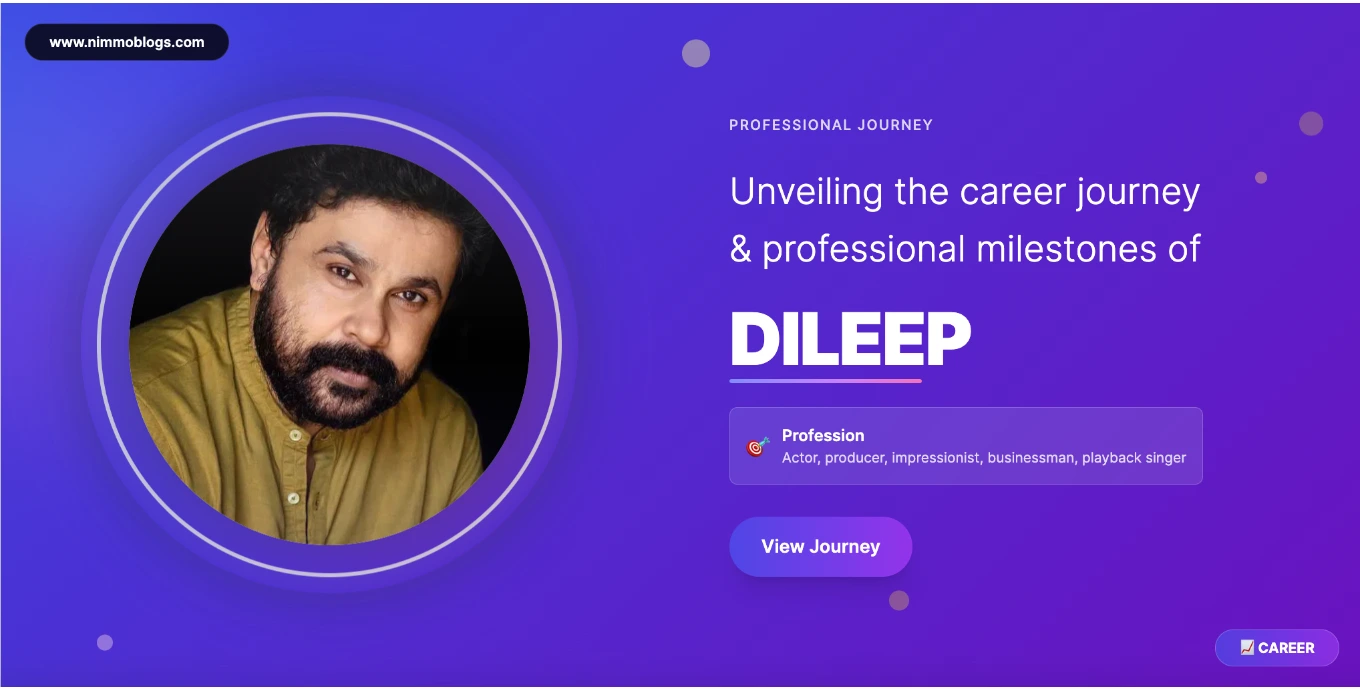
The year 2002 marked a watershed moment in Dileep's career with the release of Meesa Madhavan, directed by Lal Jose. This period comedy about a petty thief with a good heart became a massive blockbuster, setting new box office records for Malayalam cinema. The film's success elevated Dileep from popular actor to bona fide superstar, earning him the enduring nickname "Janapriya Nayakan." The film's combination of comedy, romance, and social commentary resonated across demographics, and Dileep's portrayal of the lovable rogue Madhavan remains one of Malayalam cinema's most iconic performances.
|
Meesa Madhavan's success also earned Dileep critical recognition. He won the Filmfare Award South for Best Actor (Malayalam) for his performance, validating his position not just as a commercial draw but as a serious actor capable of nuanced work. The film's impact extended beyond Kerala, with remakes and adaptations in other languages, introducing Dileep's work to pan-Indian audiences.
The same year, Dileep also delivered another memorable performance in Kunjikoonan, where he played a man with a hunchback who undergoes physical transformation. His sensitive portrayal earned him the Kerala State Film Award Special Jury Award, proving his range extended beyond comedy into emotionally complex territories. The dual success of Meesa Madhavan and Kunjikoonan in 2002 established Dileep as Malayalam cinema's most versatile and bankable star.
Peak Years: Commercial Dominance (2003-2015)
Following his breakthrough, Dileep dominated the Malayalam box office throughout the 2000s and early 2010s with a string of successful films. C.I.D. Moosa (2003), which he also produced under Graand Production, became a cult comedy classic. The film's spoofing of detective genres and Dileep's energetic performance made it a favorite, particularly among younger audiences. Its dialogues and scenes continue to be referenced in popular culture decades later.
Other significant films from this golden period include Chanthupottu (2005), where he played a young man raised as a girl, challenging gender stereotypes while maintaining family-friendly entertainment values. Bodyguard (2010) became another major commercial success and was remade in multiple Indian languages, including a Hindi version starring Salman Khan. Mayamohini (2012) showcased Dileep in female disguise, demonstrating his fearlessness in taking on unconventional roles for the sake of entertainment.
The 2011 film Vellaripravinte Changathi marked a career highlight, earning Dileep the prestigious Kerala State Film Award for Best Actor. The period film, set in the 1950s and 60s, showcased his dramatic r'60se and ability to anchor serious narratives. His performance was praised for its restraint and emotional depth, proving once again that beneath the comic exterior lay a formidable dramatic actor.
Two Countries (2015) became one of the highest-grossing Malayalam films at that time, cementing Dileep's position as box office royalty even in an increasingly competitive market. The film's success demonstrated his continued relevance and ability to draw audiences despite the emergence of younger stars and changing cinematic tastes.
Producer & Entrepreneur
Beyond acting, Dileep established Graand Production as a significant production house in Malayalam cinema. The company produced several commercially successful films, with Dileep often starring in them. The most ambitious project was Twenty:20 (2008), a multi-starrer featuring virtually every major Malayalam actor of the time. The film was specifically created to raise funds for the Association of Malayalam Movie Artists (AMMA), the industry's actors' union. This initiative demonstrated Dileep's commitment to industry welfare and his organizational capabilities.
Dileep also ventured into film exhibition, previously owning D Cinemaas, a multiplex theater in Chalakudy, Kerala. This vertical integration—from production to exhibition—reflected his business acumen and understanding of the film industry's complete value chain. While he later sold the multiplex, the venture provided valuable insights into audience preferences and distribution dynamics.
Recent Work & Current Status
Dileep continued his successful run with films like Ramaleela (2017), a political thriller that became a major box office success, and Kammara Sambhavam (2018), an ambitious period satire that showcased his willingness to experiment with complex narratives. His performance in Kammara Sambhavam, which required extensive makeup and physical transformation to portray a character across different ages, demonstrated his continued commitment to challenging roles.
More recently, Keshu Ee Veedinte Nadhan (2021) saw Dileep adapting to the OTT (streaming) era, with the film releasing on digital platforms during the COVID-19 pandemic. His willingness to embrace changing distribution models while maintaining his core audience demonstrates professional adaptability. With over 130 films to his credit and a career spanning three decades, Dileep remains one of Malayalam cinema's most enduring and commercially successful actors.
Dileep's Net Worth & Financial Success
Dileep's exact net worth is not publicly disclosed, as is common with many South Indian film personalities who prefer to keep financial details private. However, industry analysts and media reports suggest substantial wealth accumulated through a prolific three-decade career spanning over 130 films, successful production ventures, and business investments. His earnings derive from multiple revenue streams, including acting fees, film production profits, brand endorsements, and real estate investments.
Income Sources & Earnings Breakdown
| Income Source | Details |
|---|---|
| Acting Career | 130+ Malayalam films (1992-2025); project-based remuneration |
| Film Production | Graand Production - produced multiple commercially successful films |
| Per Movie Fee | Estimated $240,000-$360,000 (₹2-3 crore) per film at career peak |
| Business Ventures | Previously owned D Cinemaas multiplex; real estate investments |
| Brand Endorsements | Regional brand partnerships in Kerala market |
| Playback Singing | Additional income from singing in own films |
| Television Appearances | Guest appearances, reality show participation |
For the US context, Dileep's per-film earnings at his peak would place him among the highest-paid actors in regional Indian cinema, though significantly lower than Bollywood's top tier. However, the Malayalam film industry operates on different budget scales than Hindi cinema. A film budgeted at $3-6 million (₹25-50 crore) is considered big-budget in Malayalam cinema, compared to Bollywood blockbusters that can exceed $30-60 million (₹250-500 crore).
Dileep's production company, Graand Production, has generated substantial revenue through successful films. C.I.D. Moosa, Twenty:20, productions not only enhanced his creative control but also provided producers' profits beyond acting fees. The Twenty:20 project, despite being a charitable initiative for AMMA, reportedly generated significant revenues, demonstrating its ability to manage large-scale productions.
Assets & Lifestyle
Dileep maintains a relatively understated lifestyle compared to some contemporaries in Indian cinema. He owns properties in Kerala, including residential real estate in prime locations around Kochi and Ernakulam. His primary residence is in Kerala, where he lives with his wife Kavya Madhavan and daughter Mahalakshmi.
While specific details of his vehicle collection are not comprehensively disclosed, media reports associate him with premium vehicles in the SUV and sedan segments, with an estimated combined value between $60,000-$240,000 (₹50 lakh-₹2 crore). His approach to luxury appears pragmatic rather than ostentatious, focusing on investments that appreciate in value rather than conspicuous consumption.
The ownership and subsequent sale of D Cinema's multiplex represented a significant business venture. Multiplex ownership in India requires substantial capital investment, and his involvement in this sector demonstrated diversification beyond traditional film-related income. Real estate investments in Kerala's growing urban centers likely form a significant portion of his asset portfolio, providing long-term wealth security.
Financial Philosophy & Wealth Management
Colleagues and industry insiders describe Dileep as financially prudent and business-minded. Unlike some actors who focus solely on artistic pursuits, Dileep has consistently demonstrated interest in the business aspects of cinema—from production budgets to distribution strategies and exhibition economics. This comprehensive understanding has enabled him to maximize earnings while maintaining creative satisfaction.
His middle-class upbringing instilled values of financial responsibility that continue to guide his approach to wealth. Rather than excessive spending on luxury items, he has focused on building sustainable businesses, investing in property, and ensuring long-term financial security for his family. This approach reflects a pragmatic understanding that acting careers, however successful, require complementary income streams for lasting financial stability.
Dileep's Movies & Box Office Success
Dileep's filmography of over 130 films represents one of the most prolific careers in Malayalam cinema. His body of work spans comedy, drama, action, romance, and period films, showcasing remarkable versatility. The common thread through most of his films is their family-friendly entertainment value and strong connection with middle-class sensibilities—factors that have made him a consistent box office draw across three decades.
Major Films & Career Highlights
| Film | Year | Genre | Significance | Box Office |
|---|---|---|---|---|
| Manathe Kottaram | 1994 | Comedy-Drama | First lead role; adopted stage name from character | Hit |
| Ee Puzhayum Kadannu | 1996 | Romance | Established romantic hero image | Superhit |
| Sallapam | 1996 | Romance-Drama | Opposite Manju Warrier; strong chemistry | Hit |
| Kunjikoonan | 2002 | Drama-Comedy | Kerala State Special Jury Award; dual role | Superhit |
| Meesa Madhavan | 2002 | Period Comedy | Career-defining; Filmfare Award; box office record | Industry Hit |
| C.I.D. Moosa | 2003 | Comedy | Cult classic; detective spoof; self-produced | Superhit |
| Chanthupottu | 2005 | Comedy-Drama | Gender-bending role; critical acclaim | Hit |
| Bodyguard | 2010 | Action-Romance | Remade in multiple languages including Hindi | Blockbuster |
| Vellaripravinte Changathi | 2011 | Period Drama | Kerala State Film Award for Best Actor | Hit |
| Mayamohini | 2012 | Comedy | Female disguise role; strong commercial success | Superhit |
| Two Countries | 2015 | Comedy-Romance | Career-high gross; international locations | Industry Hit |
| Ramaleela | 2017 | Political Thriller | Different genre exploration; strong performance | Superhit |
| Kammara Sambhavam | 2018 | Period Satire | Ambitious narrative; extensive makeup transformation | Hit |
| Keshu Ee Veedinte Nadhan | 2021 | Family Drama | OTT release; pandemic-era adaptation | Streaming Success |
Box Office Track Record
Dileep's box office consistency is legendary in Malayalam cinema. From the mid-1990s through the 2010s, having a Dileep film virtually guaranteed theatrical success, making him a producer's dream and a distributor's safe bet. Films like Meesa Madhavan, C.I.D. Moosa, Bodyguard, and Two Countries not only recovered their budgets but generated substantial profits, often running in theaters for over 100 days—a significant milestone in regional cinema.
For US audiences, understanding the scale requires context. Malayalam cinema operates in a market of approximately 35 million native speakers in Kerala, with diaspora audiences in the Middle East, North America, and other regions. A film collecting $6-12 million (₹50-100 crore) is considered a massive blockbuster in this market. Meesa Madhavan's success in 2002, when it became the highest-grossing Malayalam film, represented a watershed moment comparable to major Bollywood blockbusters within its market context.
The remakes of Dileep's films into other Indian languages testify to their universal appeal. Bodyguard was remade in Tamil, Telugu, and most notably in Hindi with Salman Khan, becoming one of the highest-grossing Hindi films of 2011. This cross-linguistic appeal demonstrates the strength of the original narratives and Dileep's performances, which transcended regional boundaries.
Streaming Era & International Reach
With the advent of OTT platforms like Netflix, Amazon Prime Video, and Disney+ Hotstar, Dileep's films have found new audiences beyond Kerala. Many of his classic films are now available with subtitles, allowing non-Malayalam speakers, including US audiences interested in Indian regional cinema, to discover his work. Films like Meesa Madhavan, C.I.D. Moosa and Kunjikoonan have gained cult followings among diaspora communities and cinema enthusiasts exploring South Indian films.
The COVID-19 pandemic accelerated this shift, with Keshu Ee Veedinte Nadhan releasing directly on streaming platforms. This adaptation to changing distribution models while maintaining core audience appeal demonstrates Dileep's and Malayalam cinema's evolution in the digital age. For international viewers, these platforms have democratized access to regional Indian cinema, previously difficult to access outside India.
Dileep's Physical Appearance & Style
| Height | 5'7" (171 cm) |
|---|---|
| Weight | 172 lbs (78 kg approximately) |
| Body Type | Medium build, athletic |
| Eye Color | Black |
| Hair Color | Black (natural) |
| Skin Tone | Wheatish complexion |
| Body Measurements | Chest: 40 in; Waist: 34 in; Biceps: 13 in (approx.) |
| Distinctive Features | Expressive face, warm smile, characteristic voice |
| Fitness Approach | Regular gym workouts, maintains functional fitness |
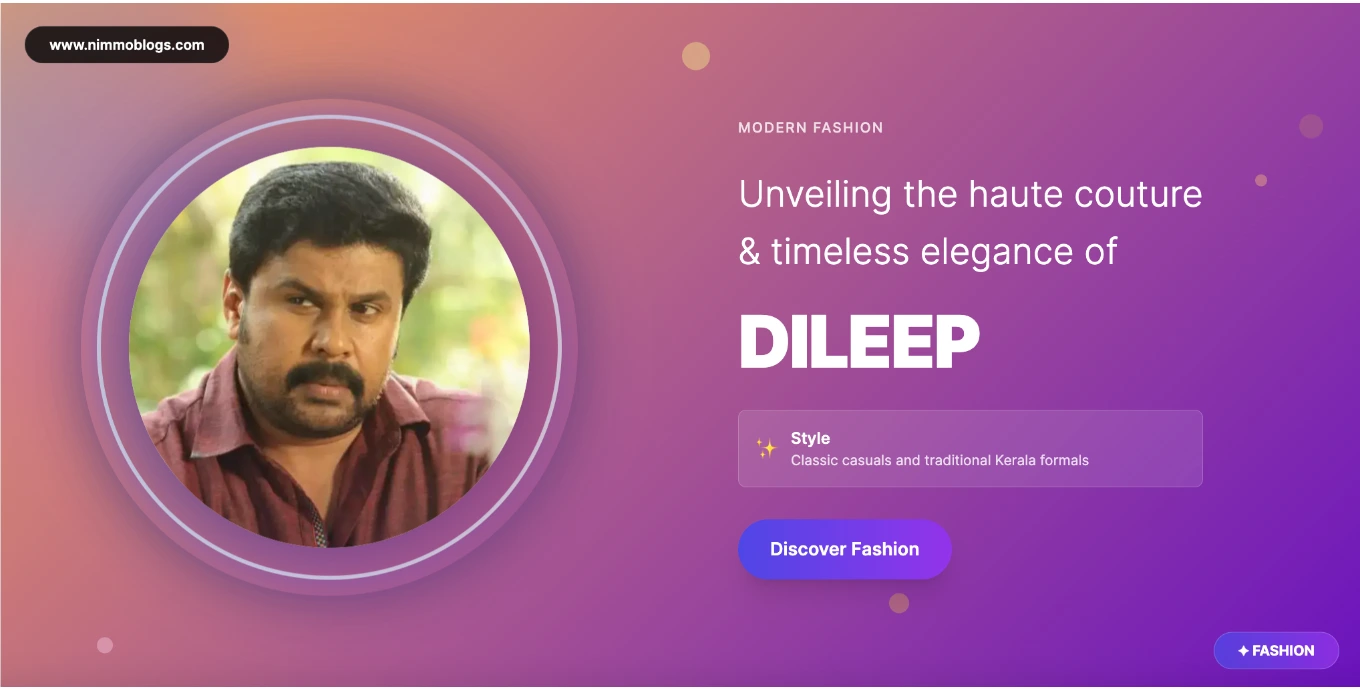
Dileep possesses a physical presence that perfectly complements his everyman screen persona. Standing at 5'7" (171 cm), he represents the average Indian male height, contributing to his relatability with mass audiences. Unlike action heroes who emphasize imposing physiques, Dileep's medium athletic build suits the comedy and family drama roles that form his filmography's core.
|
His most distinctive feature is his expressive face, which can shift seamlessly from comedy to pathos—a skill honed through years of mimicry and stage performance. His eyes convey emotion effectively, crucial for both comic timing and dramatic scenes. His voice, with its characteristic modulation and clarity, became an integral part of his screen identity, enhanced by his playback singing in several films.
Fashion & Style Evolution
Dileep's fashion sense reflects his middle-class roots and practical approach to style. On screen, his costumes typically serve the character rather than making fashion statements. In contemporary roles, he appears in casual shirts, simple trousers, and understated accessories. For traditional sequences, he wears the mundu (Kerala's traditional lower garment) and shirt with ease, reflecting authentic cultural representation.
Off-screen, Dileep maintains a classic, comfortable style. He is often seen in simple casual wear—shirts, t-shirts, and trousers—avoiding the high-fashion statements common among some film stars. For public events and award ceremonies, he opts for well-tailored formal wear or traditional Kerala attire, maintaining elegance without ostentation. This understated approach aligns with his overall brand as an accessible, grounded personality.
His style evolution over three decades mirrors his career trajectory. In the 1990s, his look aligned with the casual-cool aesthetic of that era's youth heroes. As he matured into family drama territory, his styling became more sophisticated while maintaining approachability. In recent years, he has maintained a timeless classic style that works across age groups and occasions.
Fitness & Health
Dileep maintains functional fitness appropriate for his roles rather than pursuing bodybuilder aesthetics. He follows regular gym routines to stay in shape for demanding shooting schedules that often require long hours and physical comedy sequences. His fitness philosophy appears practical—maintaining health and energy for work rather than achieving cover-model looks.
For roles requiring physical transformation, such as Kammara Sambhavam wa where he portrayed characters across different ages, Dileep has demonstrated willingness to undergo makeup, prosthetics, and body modifications. This commitment to character authenticity, even at the cost of vanity, distinguishes serious actors from mere stars. His approach prioritizes performance believability over maintaining a consistent glamorous image.
Dileep's Awards & Recognition
Dileep has received numerous awards and accolades throughout his three-decade career, recognizing both his commercial success and artistic merit. While commercial viability remains his primary achievement, critical recognition through state and industry awards validates his versatility and craft.
Major Awards & Honors
| Year | Award | Category | Film | Significance |
|---|---|---|---|---|
| 2002 | Kerala State Film Awards | Special Jury Award | Kunjikoonan | Recognition for portraying character with physical difference |
| 2002 | Filmfare Awards South | Best Actor - Malayalam | Meesa Madhavan | Career-defining performance; major industry recognition |
| 2011 | Kerala State Film Awards | Best Actor | Vellaripravinte Changathi | Prestigious state honor; dramatic role recognition |
| 2002-2013 | Asianet Film Awards | Best Actor (multiple) | Various | Popular choice awards; audience favorite |
| 2002-2013 | Asianet Film Awards | Most Popular Actor | Various | Consistent public appeal across years |
| Various | Other Industry Awards | Multiple categories | Various films | Numerous recognitions from film associations |
Significance of Recognition
The Kerala State Film Award for Best Actor for Vellaripravinte Changathi represents the pinnacle of regional cinema recognition in Kerala. State film awards in India carry significant prestige, awarded by government-appointed juries comprising film critics, scholars, and industry veterans. This honor placed Dileep alongside Malayalam cinema legends like Mohanlal and Mammootty in the pantheon of state-recognized actors.
The Special Jury Award for Kunjikoonan acknowledged his sensitive portrayal of a character with a physical disability—a role that could easily have been played for cheap laughs but which Dileep imbued with dignity and emotional depth. This recognition validated his ability to handle socially relevant themes within commercial cinema frameworks.
The Filmfare Award South for Meesa Madhavan came at a crucial juncture when the film was breaking box office records. Filmfare Awards, while industry-driven rather than state-sponsored, carry significant prestige across Indian cinema. Winning for a comedic role—often undervalued in awards circuits—demonstrated that the performance transcended mere entertainment to achieve artistic merit.
Box Office as Recognition
Beyond formal awards, Dileep's most consistent recognition comes from audience acceptance. His nickname "Janapriya Nayakan" (people's hero) represents unofficial but perhaps more meaningful validation—that audiences across demographics, classes, and generations embrace his work. In an industry where many critically acclaimed films struggle commercially, and many commercial successes lack critical respect, Dileep has maintained a rare balance.
Multiple films achieving 100-day theatrical runs, becoming the highest-grossers of their years, and being remade in other languages represent market-driven recognition of his value. For producers, distributors, and theater owners, Dileep's name on a project provided assurance—a form of professional recognition perhaps more valuable than trophies.
Industry Contributions
Beyond individual awards, Dileep's contributions to Malayalam cinema infrastructure deserve recognition. His production of Twenty:20 for AMMA welfare, his support of technicians and junior artists through his production company, and his previous venture into exhibition through D Cinemaas represent significant industry contributions. While these may not generate awards, they reflect commitment to cinema's ecosystem beyond personal stardom.
Dileep's Latest Projects & Updates
Recent Work (2020-2025)
Dileep has continued working consistently despite the challenges posed by the COVID-19 pandemic and evolving industry dynamics. His most recent theatrical release was Keshu Ee Veedinte Nadhan (2021), a family drama that explored father-son relationships and personal redemption. The film, which also featured his playback singing in the song "Naranga Mittayi," received positive reception for its emotional core and Dileep's mature performance.
The film's release strategy reflected pandemic-era realities, with a simultaneous or near-simultaneous OTT release on streaming platforms. This adaptation demonstrated both Dileep's and Malayalam cinema's flexibility in navigating unprecedented industry disruptions. For US audiences, such films are now readily accessible on platforms like Amazon Prime Video and Netflix with English subtitles.
Current Projects & Future Plans
| Project | Role | Director | Status | Expected Release |
|---|---|---|---|---|
| Upcoming projects | Lead Actor | Various directors | In discussion/pre-production | TBD |
| Production ventures | Producer | Via Graand Production | Development stage | TBD |
As of 2025, specific upcoming project details remain under wraps, which is typical for Malayalam cinema where announcements often ha,ppen closer to production commencement. However, industry sources indicate Dileep remains in high demand, with multiple projects in various stages of discussion and development.
Industry Position & Future Outlook
At 58 years old, Dileep occupies a unique position in Malayalam cinema. While younger actors like Dulquer Salmaan, Fahadh Faasil, and Tovino Thomas have emerged as new-generation stars, Dileep's established fan base and proven track record ensure continued relevance. Malayalam cinema, unlike some other industries, has historically honored veteran actors, providing meaty roles appropriate to their age and experience.
The trend toward character-driven narratives in contemporary Malayalam cinema suits Dileep's strengths. Films focusing on father figures, middle-aged protagonists navigating life challenges, and family dynamics provide perfect vehicles for his evolved screen presence. His willingness to collaborate with younger directors and embrace contemporary storytelling styles suggests continued career vitality.
His production company, Graand Production, continues exploring projects, though at a more selective pace than during peak years. The focus appears to be quality over quantity, backing scripts that offer both commercial viability and creative satisfaction. This measured approach reflects maturity and understanding of changing market dynamics.
Streaming Era Opportunities
The global reach of streaming platforms presents new opportunities for Dileep's work. His extensive back catalog of 130+ films represents valuable content libraries for OTT platforms catering to the Malayali diaspora and South Indian cinema enthusiasts worldwide. Many of his classic films are being digitally remastered and released with improved subtitles, introducing his work to international audiences who previously had limited access.
For US-based audiences, platforms like Netflix, Amazon Prime Video, and Disney+ Hotstar have made Malayalam cinema more accessible than ever. Dileep's films, with their universal themes of family, ambition, love, and social dynamics, translate well across cultural boundaries when properly subtitled. His comedy, rooted in situation and character rather than language-specific wordplay, often survives translation better than dialogue-heavy humor.
Dileep's Controversies & Challenges
Legal Challenges
Dileep's career faced its most significant challenge in 2017 when he was arrested in connection with a conspiracy related to the assault of a prominent Malayalam actress. The case, which has been subject to extensive legal proceedings, investigations, and media coverage, represents a major controversy in Malayalam film industry history. Dileep was arrested in July 2017 and subsequently released on bail after spending approximately 85 days in judicial custody.
Multiple investigative proceedings, forensic examinations, and legal petitions continued through 2019-2022. In 2022, he was granted anticipatory bail in a related conspiracy case. The legal proceedings remain ongoing as of 2025, with various appeals and investigations at different stages in Kerala's judicial system. Given the ongoing legal nature of these matters, specific details and allegations are subject to judicial determination.
The case significantly impacted his public image and professional standing. During the initial periods following his arrest, several projects were put on hold, and his association with industry bodies became contentious. The Malayalam film industry itself faced scrutiny regarding workplace safety, power dynamics, and institutional responses to serious allegations.
Professional Impact
The controversy had tangible effects on Dileep's career trajectory. Film releases were delayed, some projects were shelved, and there was evident hesitation among certain filmmakers and production houses to collaborate during the legal proceedings' peak periods. His membership in industry associations, including AMMA (Association of Malayalam Movie Artists), became a point of debate and organizational turmoil.
However, Dileep gradually resumed work, with films like Ramaleela (2017), Kammara Sambhavam (2018), and later Keshu Ee Veedinte Nadhan (2021) being completed and released. The commercial performance of these films demonstrated that significant portions of his traditional fan base remained supportive, though public opinion has remained divided.
Industry & Social Dynamics
For US audiences trying to understand the context, it's important to note that the Indian film industry operates within complex social dynamics around celebrity, power, gender relations, and institutional accountability. The case sparked broader conversations about workplace safety in cinema, women's rights, and the responsibilities of industry bodies in addressing serious allegations against powerful members.
The Women in Cinema Collective (WCC), formed in the wake of these events, has become a significant voice advocating for gender equality, safety protocols, and institutional reforms in Malayalam cinema. The controversy thus extends beyond individual allegations to systemic questions about industry culture and governance.
Current Status
As of 2025, Dileep continues to work in Malayalam cinema while legal proceedings remain in various stages. Public opinion remains divided—some maintain belief in his innocence pending final judicial determination, while others have distanced themselves based on the serious nature of the allegations. The ultimate resolution of legal matters will likely significantly influence how this chapter of his career is historically remembered.
It's important to note that in discussing these matters, the principles of natural justice apply—allegations remain allegations until proven in competent courts of law, while simultaneously, the severity of accusations demands serious institutional and societal response. The full truth, as determined through judicial processes, remains pending.
Dileep's Interesting Facts & Trivia
Beyond the headlines and box office numbers, Dileep's life and career contain numerous fascinating details that reveal the person behind the persona. These lesser-known facts showcase his journey, personality, and unique contributions to Malayalam cinema.
- Stage Name Origin: Dileep's professional name comes from his character in the 1994 film Manathe Kottaram. The name resonated so strongly with audiences and industry personnel that Gopalakrishnan Padmanabhan Pillai adopted it permanently, essentially allowing his first successful character to define his public identity.
- Mimicry Roots: Before becoming a film star, Dileep was a sought-after mimicry artist in Kerala. His ability to imitate actors like Mammootty, Mohanlal, and various politicians made him popular in the local entertainment circuit. This foundation in impersonation significantly influenced his comedic timing and versatility as an actor.
- Assistant Director Experience: Dileep worked as an assistant director under filmmaker Kamal before transitioning to acting. This behind-the-scenes experience provided a comprehensive understanding of filmmaking processes, which later proved invaluable in his production ventures.
- Television Pioneer: He was among the first generation of Malayalam television personalities when Asianet launched in 1993. His work on Comicola and Cinemala helped establish television as a legitimate entertainment medium in Kerala, creating a template for many comedy shows that followed.
- Playback Singing: Dileep has sung in several of his own films, including memorable tracks in Chandranudikkunna Dikhil, Kalyanaraman, Thilakkam, Sound Thoma, and Keshu Ee Veedinte Nadhan. His singing, while not professionally trained, adds a personal touch to his films and demonstrates his multi-talented entertainment background.
- Twenty:20 Achievement: The 2008 film Twenty:20, which Dileep produced through Graand Production, featured virtually every major Malayalam actor in a single film—an unprecedented achievement. The project was specifically created to raise funds for AMMA (Association of Malayalam Movie Artists), demonstrating its organizational capabilities and iCinemasstanding.
- Theater Owner: Dileep previously owned D Cinemas, a multiplex in Chalakudy, Kerala. This venture made him one of the few Malayalam actors to be involved in the exhibition side of cinema, providing insights into audience preferences and distribution dynamics from a theater owner's perspective.
- Cross-Language Remakes: Multiple Dileep films have been remade in other Indian languages. Most notably, Bodyguard was remade in Tamil, Telugu, and Hindi (starring Salman Khan), with the Hindi version becoming one of 2011's highest-grossing films. This cross-linguistic success demonstrates the universal appeal of his film narratives.
- Character Transformation Commitment: For Kammara Sambhavam (2018), Dileep underwent extensive makeup and prosthetics to portray his character across different ages, including an elderly version requiring hours of daily preparation. This commitment to physical transformation shows dedication to character authenticity over maintaining vanity.
- Dual Success in 2002: The year 2002 was pivotal, with both Meesa Madhavan and Kunjikoonan releasing to critical and commercial success. This dual achievement—combining a box office record-breaker with an award-winning performance in the same year—represents a rare career peak.
- Consistent Box Office Draw: From the mid-1990s through the 2010s, Dileep maintained remarkable consistency, with the majority of his films achieving commercial success. This reliability made him a preferred choice for producers and distributors seeking safe investments.
- Middle-Class Hero: Unlike many stars who portray wealthy characters, Dileep's on-screen persona often represents middle-class or working-class individuals. This relatability factor significantly contributed to his mass appeal, as audiences saw themselves reflected in his characters' struggles and triumphs.
- Longevity Record: With a career spanning over three decades and 130+ films, Dileep represents one of the longest continuously successful careers in Malayalam cinema. Few actors maintain both commercial viability and audience affection across such extended periods.

|
These facts collectively paint a picture of an entertainer who built success through talent, hard work, and strategic career decisions. From mimicry stages to becoming "Janapriya Nayakan," Dileep's journey represents a distinctly Malayalam success story—rooted in local culture while achieving broader regional recognition.
Dileep's Social Media & Fan Following
Dileep maintains a relatively modest social media presence compared to contemporary actors who actively leverage digital platforms for fan engagement. Unlike many current-generation stars who have embraced Instagram, Twitter, and YouTube as primary communication channels, Dileep's approach to social media remains selective and measured.
Digital Presence
| Platform | Official Presence | Engagement Style | Content Type |
|---|---|---|---|
| Limited verified presence | Occasional updates | Film promotions, selected personal moments | |
| Twitter/X | Not actively maintained | Minimal | Rare official statements |
| Fan pages (unofficial) | Fan-driven content | Film updates, photos, fan tributes | |
| YouTube | Through film channels | Indirect presence | Film clips, songs, promotional content |
This relatively low-key digital footprint reflects both generational factors and personal preference. Dileep belongs to a generation of actors who built their careers before social media became essential for celebrity branding. His established fan base, cultivated through decades of theatrical releases and television appearances, doesn't require constant digital reinforcement that newer actors depend on.
Fan Base & Community
Despite minimal official social media activity, Dileep enjoys a dedicated and passionate fan following, particularly in Kerala and among the Malayali diaspora worldwide. Fan clubs and associations exist across Kerala, organizing theater bookings for new releases, conducting charitable activities in his name, and maintaining online communities dedicated to his work.
These fan communities operate independently, creating content, sharing memories of his films, and defending his legacy during controversies. The organic nature of this fandom—built on theatrical experiences rather than curated social media personas—represents old-school celebrity culture where the work itself creates the connection rather than behind-the-scenes lifestyle content.
Media Engagement
Dileep's primary public engagement occurs through traditional media—film promotional events, award ceremonies, television interviews, and print media interactions. He participates in promotional campaigns for his releases but generally maintains privacy regarding personal matters. This approach aligns with many South Indian actors who draw clear boundaries between public and private life.
His relationship with the media has been complex, particularly following the 2017 legal controversies. While promotional duties require media interaction, he has become more selective about interviews and public appearances, focusing primarily on film-related activities rather than personal discussions.
US Audience & International Fans
For the US-based Malayali diaspora, the Ileep represents nostalgia and cultural connection. His films, particularly classics like Meesa Madhavan and C.I.D. Moosa are staples at community gatherings and cultural events. The availability of his films on streaming platforms with English subtitles has introduced his work to non-Malayali audiences interested in South Indian cinema.
International fan engagement happens primarily through streaming platforms' comment sections, Malayalam cinema discussion forums, and diaspora community groups. While Dileep may not have millions of Instagram followers like contemporary pan-Indian stars, his cultural impact within Malayalam-speaking communities worldwide remains substantial.
Frequently Asked Questions About Dileep
Personal Information
What is Dileep's real name?
Dileep's real name is Gopalakrishnan Padmanabhan Pillai. He adopted the stage name "Dileep" from his character in the 1994 film Manathe Kottaram, which became his breakthrough movie as a lead actor. The name resonated so strongly with audiences that it became his permanent professional identity, effectively replacing his birth name in public consciousness.
How old is Dileep in 2025?
Dileep is 58 years old as of 2025. He was born on October 27, 1967, in Edavanakkad, Ernakulam district, Kerala, India. His zodiac sign is Scorpio. Despite being nearly six decades old, he continues to work actively in Malayalam cinema, adapting his roles to suit more mature characters while maintaining his comedic strengths.
What is Dileep's height and weight?
Dileep stands 5 feet 7 inches (171 cm) tall and weighs approximately 172 lbs (78 kg). He maintains a medium athletic build with chest measurement of about 40a inches, waist of 34 inches, and biceps of 13 inches. His physical stature suits the everyman roles that form his filmography's core, contributing to his relatability with mass audiences rather than emphasizing action-hero physiques.
Is Dileep married? Who is his wife?
Yes, Dileep is currently married to Kavya Madhavan, a popular Malayalam actress. They married on November 25, 2016, in Kochi, Kerala. This is Dileep's second marriage. He was previously married to actress Manju Warrier from 1998 to 2015. Dileep and Kavya have one daughter together, Mahalakshmi Dileep, born in 2018. He also has another daughter, Meenakshi Dileep, from his previous marriage with Manju Warrier.
How many children does Dileep have?
Dileep has two daughters. His elder daughter, Meenakshhi Dileep, was born in 1999 from his marriage with actress Manju Warrier. His younger daughter, Mahalakshmi Dileep, was born in 2018 from his current marriage with actress Kavya Madhavan. Both daughters are kept relatively away from the public spotlight, with Dileep maintaining privacy regarding their personal lives and education.
Where was Dileep born?
Dileep was born in Edavanakkad, Ernakulam district, Kerala, India. Edavanakkad is a coastal village near Kochi (formerly Cochin), Kerala's commercial capital. He grew up in the nearby town of Aluva, also in Ernakulam district, where he completed his schooling and college education. He continues to be based primarily in Kerala, maintaining strong connections to his roots despite decades of stardom.
What is Dileep's educational background?
Dileep completed his schooling at Vidyadhiraja Vidya Bhavan Higher Secondary School in Aluva. He then pursued pre-degree education at Union Christian College, Aluva, and obtained his Bachelor's degree in History from Maharaja's College, Ernakulam, affiliated with Mahatma Gandhi University. However, his passion for entertainment, developed through participation in mimicry troupes during his college years, eventually overtook his academic pursuits, leading him toward a career in cinema.
Career & Professional Life
How did Dileep start his career?
Dileep began his entertainment career as a mimicry artist performing with local troupes in Kerala during the late 1980s. He gained recognition through television shows Comicola and Cinemala on Asianet in the early 1990s, which showcased his impressionist skills and comedic timing. He also worked as an assistant director under filmmaker Kamal before making his acting debut with a minor role in Ennodu Ishtam Koodamo (1992). His breakthrough as a lead actor came with Manathe Kottaram in 1994.
Which film made Dileep a superstar?
Meesa Madhavan (2002) catapulted Dileep to superstardom in Malayalam cinema. The period comedy about a petty thief with a good heart became the highest-grossing Malayalam film at that time, breaking box office records. The film's massive success earned Dileep the nickname "Janapriya Nayakan" (people's hero) and established him as one of Malayalam cinema's most bankable stars. He also won the Filmfare Award South for Best Actor (Malayalam) for this iconic performance.
How many movies has Dileep acted in?
Dileep has acted in over 130 films throughout his career spanning more than three decades (1992-2025). The vast majority of these are Malayalam films, though he has also appeared in select Tamil, Kannada, and Hindi projects. His prolific filmography includes diverse genres from comedy and family drama to action and period films, showcasing remarkable versatility and sustained productivity.
What are Dileep's most successful movies?
Dileep's biggest hits include Meesa Madhavan (2002), which became the highest-grossing Malayalam film of its time; C.I.D. Moosa (2003), a cult comedy classic; Bodyguard (2010), which was remade in multiple languages including Hindi; Mayamohini (2012), a major commercial success; Two Countries (2015), one of his career-high grossers; and Ramaleela (2017), a political thriller that performed strongly. Other notable successes include Kunjikoonan, Chanthupottu, Vellaripravinte Changathi, and Kammara Sambhavam.
Has Dileep won any awards?
Yes, Dileep has won several prestigious awards. He received the Kerala State Film Award for Best Actor for Vellaripravinte Changathi (2011), one of Malayalam cinema's highest honors. He also won the Kerala State Film Award Special Jury Award for Kunjikoonan (2002) and the Filmfare Award South for Best Actor (Malayalam) for Meesa Madhavan (2002). Additionally, he has won multiple Asianet Film Awards, including Best Actor and Most Popular Actor categories across different years.
Has Dileep produced films?
Yes, Dileep is an active film producer through his production company Graand Production. He has produced several commercially successful films, including C.I.D. Moosa (2003) and the star-studded Twenty:20 (2008), which featured virtually every major Malayalam actor and was created specifically to raise funds for the Association of Malayalam Movie Artists (AMMA). His production ventures demonstrate business acumen alongside his acting career.
Does Dileep sing in his movies?
Yes, Dileep has performed playback singing in several of his films. Notable songs include "Theme Music" from Chandranudikkunna Dikhil (1999), "Onnaam Malakerii" from Kalyanaraman (2002), "Saare Saare" from Thilakkam (2003), "Kandaal Njaanoru" from Sound Thoma (2013), and "Naranga Mittayi" from Keshu Ee Veedinte Nadhan (2022). While not a professionally trained singer, his playback work adds personal touches to his films and reflects his multi-talented entertainment background rooted in mimicry and stage performance.
Financial & Net Worth
What is Dileep's net worth in 2025?
Dileep's exact net worth is not publicly disclosed, as is common with many South Indian film personalities. However, industry estimates suggest substantial wealth accumulated through a prolific 30+ year career spanning 130+ films, successful production ventures through GrCinemasuction, and business investments, including previous ownership of CCinema's multiplexes. His wealth comes from acting fees, film production profits, brand endorsements, real estate investments, and other business ventures.
How much does Dileep charge per movie?
While exact figures are not officially disclosed, industry reports suggest Dileep charged approximately $240,000-$360,000 (₹2-3 crore) per film at his career peak in the 2010s. These rates place him among the highest-paid actors in Malayalam cinema. However, fees vary based on project budget, production house, role scope, and current market dynamics. For comparison, Malayalam cinema operates on different budget scales than Bollywood, where top stars command significantly higher fees.
What businesses does Dileep own?
Dileep founded Graand Production, his film production company that has produced several successful Malayalam films. He previously owned D Cinemas , a multiplex in Chalakudy, Kerala, though he later sold this venture. He also has investments in real estate across Kerala. His business portfolio reflects vertical integration understanding—from production to exhibition—providing income diversification beyond acting fees.
Does Dileep own any luxury cars?
While specific details of Dileep's vehicle collection are not comprehensively disclosed publicly, media reports associate him with premium vehicles in the SUV and luxury sedan segments. Estimates suggest his automotive collection's combined value ranges between $60,000-$240,000 (₹50 lakh-₹2 crore). However, unlike some contemporaries who showcase luxury possessions publicly, Dileep maintains a relatively understated approach to displaying wealth.
Where does Dileep live?
Dileep resides primarily in Kerala, India, maintaining his base in the Ernakulam/Kochi region where he grew up. He owns properties in prime locations across Kerala, including residential, real estate in Kochi's upscale areas. He lives with his wifwifeavya Madhavan, and daughter, Mahalakshmi Dileep. Despite decades of stardom, he has remained rooted in Kerala rather than relocating to Mumbai or other major Indian metro cities, reflecting his strong regional identity.
Personal & Lifestyle
What is Dileep's favorite food?
Dileep is known to enjoy traditional Kerala cuisine, particularly rice-based dishes and seafood preparations that are staples of coastal Kerala cooking. Like many Keralites, he appreciates authentic local flavors, including fish curry, appam with stew, and various coconut-based preparations. His food preferences reflect his middle-class Kerala roots and cultural upbringing in a region famous for its distinctive culinary traditions.
What are Dileep's hobbies?
Beyond cinema, Dileep's interests include mimicry and impressionism—the skills that launched his entertainment career. He also enjoys singing, as evidenced by his playback performances in several films. He has demonstrated interest in business ventures beyond acting, including production and previous theater ownership. His hobbies reflect the multifaceted entertainer background that distinguishes him from actors who focus solely on performance aspects.
Is Dileep active on social media?
Dileep maintains a relatively modest social media presence compared to contemporary actors. He has an imited verified presence on Instagram with occasional updates primarily focused on film promotions and selected personal moments. He is not actively maintained on Twitter/X, and most Facebook presence consists of fan-run pages rather than official accounts. His approach to social media remains selective and measured, reflecting generational factors and personal privacy preferences.
What is Dileep's fitness routine?
Dileep maintains functional privacy preferences, regular gym workouts appropriate for his age and role requirements. Rather than pursuing bodybuilder aesthetics, he focuses on maintaining health and energy for demanding shooting schedules. His fitness philosophy appears practical—staying in shape for work while aging gracefully rather than attempting to maintain youthful physiques. For roles requiring physical transformation, he has demonstrated a willingness to undergo extensive makeup and prosthetics.
Controversies & Legal Matters
Dileep's career faced a significant challenge when he was arrested in July 2017 in connection with a conspiracy related to an actress's assault case. He spent approximately 85 days in custody before being granted bail. The case has involved extensive legal proceedings, investigations, and media coverage through 2022 and continues in various stages as of 2025. He was granted anticipatory bail in a related conspiracy case in 2022. The legal matters remain pending in Kerala's judicial system, and given their ongoing nature, specific allegations are subject to judicial determination.
How did the 2017 case affect Dileep's career?
The legal controversies significantly impacted Dileep's career and public image. Several projects were delayed or put on hold during initial periods, and his association with industry bodies became contentious. However, he gradually resumed work, with films like Ramaleela (2017), Kammara Sambhavam (2018), and Keshu Ee Veedinte Nadhan (2021) completing production and release. The commercial performance demonstrated continued support from portions of his traditional fan base, though public opinion remains divided. The full career impact depends partially on the ultimate legal resolution of the pending matters.
Films & Streaming
Where can I watch Dileep movies online?
Many of Dileep's films are available on major streaming platforms including Amazon Prime Video, Netflix, Disney+ Hotstar, and other regional OTT services. Popular titles like Meesa Madhavan, C.I.D. Moosa, Kunjikoonan, Bodyguard, and Mayamohini are available with English subtitles, making them accessible to non-Malayalam speaking audiences. For US viewers, these platforms have made Malayalam cinema significantly more accessible than theatrical distribution ever allowed, introducing Dileep's work to international audiences.
Which Dileep films were remade in other languages?
Bodyguard (2010) was remade in Tamil, Telugu, and most notably in Hindi starring Salman Khan (2011), with the Hindi version becoming one of that year's highest-grossing films. Several other Dileep films have inspired remakes or adaptations in other South Indian languages, demonstrating the universal appeal of his film narratives. The success of remakes, particularly Bodyguard in Hindi, introduced Dileep's original work to pan-Indian audiences who might not typically watch Malayalam cinema.
What is Dileep's upcoming movie?
As of 2025, specific details about Dileep's upcoming projects remain largely undisclosed, which is typical for Malayalam cinema, where announcements often happen closer to production commencement. Industry sources indicate he continues to receive offers and is in discussion for various projects in development stages. Information about confirmed upcoming releases would be announced through official production house statements and entertainment media as projects progress toward filming.
Comparisons & Context
How does Dileep compare to Mohanlal and Mammootty?
Dileep belongs to a slightly younger generation than Malayalam cinema legends Mohanlal and Mammootty, who dominated the 1980s-90s. While Mohanlal and Mammootty are considered the industry's "superstars" with unmatched versatility and critical acclaim, Dileep carved his niche as the "people's hero" (Janapriya Nayakan), focusing primarily on family, entertainment, and comedy. All three have achieved remarkable box office consistency, state awards, and longevity, though with different strengths—Mohanlal's range, Mammootty's intensity, and Dileep's mass appeal and comic timing.
Is Dileep popular outside Kerala?
While Dileep's primary fan base is in Kerala and among Malayali diaspora worldwide, his work has reached broader audiences through film remakes (particularly Bodyguard in Hindi) and streaming platforms. Among South Indian cinema enthusiasts and NRI communities in the US, the Middle East, and other regions, he is recognized as one of Malayalam cinema's major stars. However, his pan-Indian recognition remains lower than actors like Mohanlal, who have worked extensively in Hindi cinema, or contemporary stars like Dulquer Salman with a broader multi-lingual appeal.
What makes Dileep different from other Malayalam actors?
Dileep's uniqueness lies in his grassroots entertainment background—beginning as a mimicry artist and television personality before entering films. This foundation gave him exceptional comic timing and audience connection distinct from actors with film-family backgrounds or conventional entry paths. His "everyman" screen persona, focus on family entertainment, and ability to blend comedy with emotional depth created a specific niche. Additionally, his entrepreneurial ventures in production and exhibition distinguish him from purely performance-focused actors.
Why is Dileep called "Janapriya Nayakan"?
"Janapriya Nayakan" translates to "people's hero" or "popular hero" in Malayalam. The title reflects Dileep's unique connection with mass audiences across demographics. Unlike titles emphasizing intensity ("Megastar") or versatility ("Complete Actor"), "Janapriya" specifically denotes popular appeal and audience affection. The nickname originated during the Meesa Madhavan era (2002) when his box officeaudience and fan following reached peak levels, cementing his position as audiences' preferred entertainer ner.
Cultural Context for US Audiences
What is Malayalam cinema?
Malayalam cinema refers to films made in the Malayalam language, primarily produced in Kerala state in southern India. Malayalam is one of India's 22 official languages, spoken by approximately 35 million people in Kerala plus diaspora communities worldwide. Malayalam cinema is known for realistic storytelling, strong literary influences, and critical acclaim, often receiving more National Awards than larger industries like Bollywood. It represents a distinct regional cinema culture within India's diverse film ecosystem.
How big is Malayalam cinema compared to Bollywood?
Malayalam cinema operates on a much smaller scale than Bollywood (Hindi cinema) in terms of budgets, box office collections, and geographical reach. While Bollywood blockbusters can collect $60-120 million (₹500-1,000 crore), a Malayalam film collecting $12 million (₹100 crore) is considered a massive blockbuster. However, Malayalam cinema enjoys disproportionate critical acclaim, often winning more National Awards than Bollywood. For Dileep, being a top Malayalam star means regional dominance but lower pan-Indian recognition than Bollywood's biggest names.
Can I watch Dileep movies if I don't speak Malayalam?
Yes, many of Dileep's films are now available on streaming platforms with English subtitles, making them accessible to non-Malayalam speakers. Platforms like Amazon Prime Video, Netflix, and Disney+ Hotstar offer their major hits with subtitle options. His comedy, which relies heavily on situational humor and physical comedy rather than language-specific wordplay, often translates well across linguistic barriers. For US audiences interested in exploring South Indian cinema beyond Telugu and Tamil films, Dileep's work offers an accessible entry point into Malayalam cinema's entertainment tradition.
What cultural context should US audiences know about Dileep's films?
Dileep's films reflect Kerala's unique cultural context—a state with near-universal literacy, progressive social movements, strong literary traditions, and distinctive aesthetics. Themes often include family values, social mobility, caste dynamics (though usually handled lightly), and the tension between tradition and modernity. His films frequently feature the Malayali middle class, their aspirations, humor, and challenges. Understanding that Kerala has a different social fabric than stereotypical "Indian" portrayals in Western media helps appreciate the specific cultural nuances in his work.

|
Last Updated: November 12, 2025
Article Category: Malayalam Cinema | Celebrity Biographies | South Indian Actors
Related Articles
Explore the journeys of remarkable individuals who continue to inspire across industries and cultures with their unique contributions.
- Nivin Pauly Biography, Age, Net Worth, Height, Movies & Facts
- Amala Paul Biography: Age, Net Worth, Movies & Facts
- Pearle Maaney Biography, Age, Net Worth, Height & Movies
- Deepika Pilli Biography, Age, Net Worth, Height & Facts
- Rena Fathima (Bigg Boss Malayalam 7) Biography, Age, Net Worth, Height, Movies & Facts
- Rena Fathima (Bigg Boss Malayalam 7) Biography, Age, Net Worth, Height, Movies & Facts
- Sarika KB Biography, Age, Net Worth, Career, Bigg Boss Malayalam 7 & Facts
- Praveen P (Bigg Boss Malayalam 7) Biography, Age, Net Worth, Height, Career & Facts
- Adhila Nasarin Biography, Age, Net Worth, Bigg Boss Malayalam 7 & 2025 Updates
- Fathima Noora Biography, Age, Net Worth, Bigg Boss Malayalam 7 & 2025 Updates
- Shanavas Shanu Biography, Age, Net Worth, Malayalam Serials & Bigg Boss 7 Updates 2025
- RJ Bincy Biography, Age, Net Worth, Height & Bigg Boss Malayalam 7 Facts
- Oneal Sabu FC Boy Biography: Maritime Lawyer Turned Culinary Star, Age, Net Worth & 2025 Updates
- Anumol RS Biography, Age, Net Worth, Height, Movies & Facts
- Aryan Kathuria Biography, Age, Net Worth, Height, Movies & Facts
For more celebrity biographies from Malayalam, Tamil, Telugu, and Bollywood cinema, visit our complete celebrities section.

Goal Setting: How To Set Goal In Life

Podcast: How To Cancel Spotify Premium

Podcast: Podcast That Should Listen

Podcast: What Is Google Podcast
Podcast: What Is Podcast And How Does It Works

Time Management: Good Time Management Skills

Time Management: How To Improve Time Management Skills

Top 25 Ways To Increase Productivity

Robotics: What Is Robotics And How Does It Work

Positive Thoughts: Positive Thoughts Can Change Your Life

How To Become Rich With No Money

Top 5 Ways To Become A Rich

Communication: Top 7 Ways To Communicate Effectively

Personality Development Tips For Men

Personality Development Tips For Woman
©2026 Nimmoblogs
All Right Reserved.
Made with
 by Hina Aggarwal